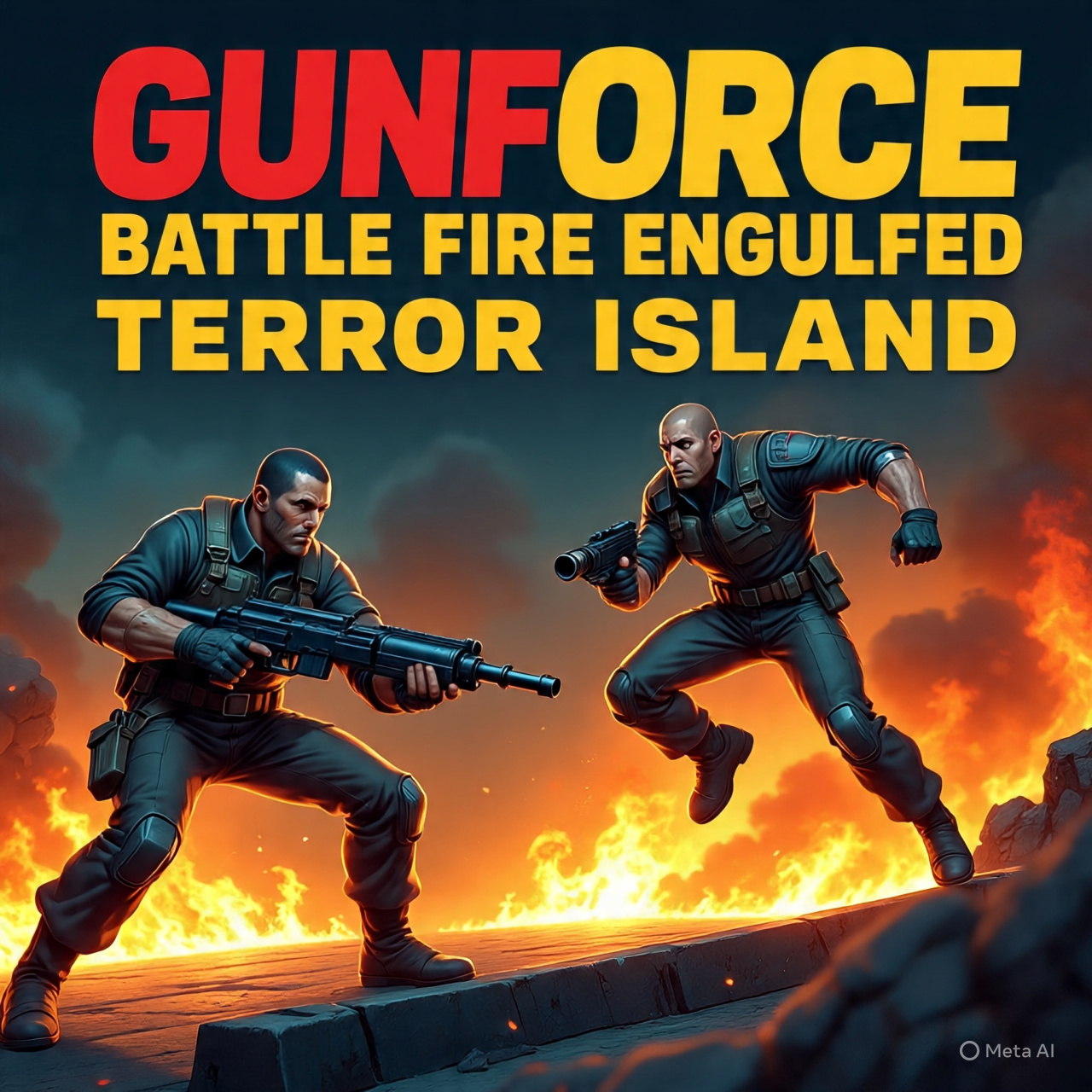
Play Gunforce – Battle Fire Engulfed Terror Island (USA)
GunForce: Battle Fire Engulfed Terror Island (USA)
A Forgotten SNES Run-and-Gun Classic
Introduction
Released in 1992 for the Super Nintendo (SNES), GunForce: Battle Fire Engulfed Terror Island is a lesser-known but cult-favorite run-and-gun shooter developed and published by Irem America Corp. The game is the home console port of the arcade title GunForce: Battle Fire Engulfed Terror Island, originally released in 1991.
As the early ’90s saw a surge of military-themed shooters and Contra-style action games, GunForce arrived quietly on the SNES, offering intense side-scrolling action, varied weaponry, and vehicle-based segments. While not as polished or well-remembered as Contra III: The Alien Wars, it’s notable as a spiritual predecessor to Metal Slug, as many members of Irem’s team would later go on to form Nazca Corporation, creators of the beloved Metal Slug series.
Today, GunForce is considered a hidden gem among retro shooter fans, offering chaotic firefights and arcade-style gameplay with a distinct early-’90s flair.
Story and Setting
GunForce: Battle Fire Engulfed Terror Island takes place in a post-apocalyptic future where a militarized society is under siege by hostile forces. You play as a lone commando (or two in the arcade version) deployed to “Terror Island” to disrupt enemy operations and rescue hostages while dismantling heavily armed enemy installations.
Although the SNES version doesn’t emphasize narrative, the name “Terror Island” sets the tone—expect non-stop war zones, fortified bunkers, burning jungles, and high-tech bases, all loaded with danger.
Gameplay Overview
At its core, GunForce is a run-and-gun action platformer, very much in the tradition of games like Contra, Metal Slug, or Midnight Resistance. The player controls a soldier armed with a variety of firearms, who moves from left to right across enemy-infested environments, shooting, jumping, rescuing POWs, and hopping into vehicles.
Controls and Mechanics
-
Fire in multiple directions: You can shoot in eight directions, including diagonally, which is essential for taking out airborne and high-ground enemies.
-
Jump and Climb: Vertical segments are common, and you’ll often jump across platforms or climb ropes and ladders.
-
Weapon Pickups: The standard weapon can be upgraded by collecting power-ups such as:
-
Rapid-fire machine gun
-
Three-way shot
-
Laser gun
-
Flame thrower
-
Each power-up feels satisfying, although unlike Contra, the SNES GunForce does not offer simultaneous dual-wielding or bomb-style attacks.
Vehicles and Mounts
A signature feature of GunForce is the use of vehicles and mounted weaponry:
-
Motorcycles
-
Mechs
-
Hover platforms
-
Gun turrets
These can be commandeered at certain points in the levels to give you additional firepower or mobility. Vehicle segments break up the run-and-gun pacing and add variety, though control responsiveness in these moments can sometimes feel stiff compared to foot movement.
Level Design
There are five primary stages, each broken into segments that culminate in boss battles. Stages include:
-
Wasteland Jungle – Blazing fires and ruined buildings
-
Enemy Base – High-tech fortresses with electric traps
-
Military Compound – Vertical climbing and sniping enemies
-
Prison Camp – Full of POWs to rescue
-
Final Showdown – With massive enemy mechs and a fortified stronghold
Levels are linear but often have vertical components and secret areas. Hostages are scattered throughout stages; rescuing them grants bonus points and sometimes extra lives. The environmental diversity keeps things from getting stale, with jungle, industrial, and mechanical zones offering varied threats.
Graphics and Audio
Visually, GunForce is solid by early SNES standards. It doesn’t push the console as hard as later titles would, but it captures the gritty military style of early ’90s arcade games well. Sprites are detailed, with explosive animations and smooth gunfire effects. The explosion and fire effects stand out particularly well for their time.
The color palette leans toward the dark and metallic, matching the game’s grim tone. The character design, especially of the main soldier and the bosses, is reminiscent of Contra and even Aliens, reflecting the influence of Hollywood sci-fi action.
Sound and Music
The soundtrack is energetic, with driving military-style themes, rapid drum loops, and synthesized explosions. Composers leveraged the SNES’s audio capabilities reasonably well, although the music isn’t as memorable as genre contemporaries like Contra III or Metal Warriors.
Sound effects—especially gunfire and explosions—are loud and satisfying, giving each weapon a punchy presence.
Difficulty and Challenge
GunForce isn’t as punishing as some of its peers (like Super C or Contra), but it’s no cakewalk either. It features:
-
Limited continues
-
One-hit deaths
-
Aggressive enemy patterns
-
Sudden vehicle ambushes or falling hazards
Boss battles, while sometimes pattern-based, can be chaotic and require memorization and quick reflexes. Enemy bullets can flood the screen, particularly in the later levels. The game demands attentiveness and strategic use of weapon power-ups and vehicles.
However, players familiar with run-and-gun mechanics will likely find it manageable, especially with a bit of practice.
Multiplayer
Unfortunately, the SNES version of GunForce is single-player only. The arcade version allowed for two-player co-op, which made the action more chaotic and exciting. The absence of co-op in the console port is a sore spot for fans, as it would’ve made the experience much more engaging.
Legacy and Connection to Metal Slug
Although GunForce never reached the fame of Contra or Metal Slug, it played a pivotal role in the evolution of run-and-gun games. After Irem’s internal development slowed, many of the GunForce developers left to form Nazca Corporation, which went on to create the Metal Slug series for SNK.
You can see the DNA of GunForce in Metal Slug:
-
Rescue-based gameplay (POWs)
-
Vehicle integration
-
Detailed animation
-
Quirky enemy and boss designs
This makes GunForce not just a curiosity, but a proto-Metal Slug — a foundational game that paved the way for one of the most beloved action series of all time.
Reception and Modern Assessment
Upon release, GunForce received mixed reviews. Magazines often praised its variety and arcade action but critiqued it for:
-
Short length (can be completed in under an hour)
-
No co-op multiplayer
-
Slightly sluggish controls
-
Lack of innovation compared to Contra III
Over time, however, the game has found appreciation among retro gamers and SNES collectors. It’s now seen as a solid, if overlooked, shooter that’s especially interesting due to its lineage.
Conclusion
GunForce: Battle Fire Engulfed Terror Island (USA) may not be a household name among SNES classics, but it holds a valuable place in the history of arcade-style run-and-gun games. With explosive gameplay, weapon variety, and vehicle segments, it delivers an enjoyable — if short — action experience.
For those who appreciate Contra-like games or want a glimpse into the pre-Metal Slug era of Irem, GunForce is absolutely worth revisiting. It may not be the flashiest or deepest title, but it offers raw, nostalgic fun from a time when one man with a gun could take on an army — and win.